Does gear matter? My two cents to this everlasting debate

A recent vlog by Ted Forbes starts with a quote saying that every famous image taken in the past was shot with a less advanced camera than we have today. Although this is definitely true I wonder whether this has any relevance for the notorious gear matters versus gear doesn’t matter discussions?

I think it is important to distinguish between two different levels of argumentation here. One level deals with the most suitable tool one needs to get a certain image, be it a macro shot of a tiny object, a portrait of an animal in the distance or a long exposure in bright sunlight, to name only a few. Without special gear like a macro lens, a telephoto lens or a neutral density filter you won’t be able to do it. The same applies to the highly acclaimed photographers who produced the famous images quoted above. They were often using the latest gear of their time and e.g. a Cartier-Bresson would not have been able to produce some of his most famous images without his 35mm rangefinder Leica, which was so much faster to use than any other contemporary camera. But all this has nothing to do with the resulting photographs. You can easily use the right equipment for your purpose, but still shoot crappy images. And here we’re coming to the second level of argumentation. If the photographer knows his/her equipment, can “read” the ambient light and has a feel for image composition and the subject of interest s/he can produce great images irrespectively of whether s/he is using a self-made pinhole, a point-and-shoot or an expensive DSLR camera. The “gear” which in this case matters is the ability of the person using the camera to its best performance and not the quality of the equipment s/he is holding in front of his/her eyes.

I recently watched a documentary on dying trades in Germany featuring the last person to master a special technique to grind knife blades made of carbon steel to their greatest possible sharpness and durability. The processes involved were invented more than a hundred years ago and so were some of the tools he was using. The consistency with which he was producing one high quality knife after the other was amazing. Despite being used for ages, his tools were the best – if not the only – fit for the purpose. No modern machine-based workflow is able to deliver comparable results. But still – the perfectly suited equipment in the wrong hands and a day’s production would go down the drain. I thought that this story had a lot in common with photography and how the combination of the best tool for the job plus the highest possible knowledge and craftmanship leads to famous results.

In the end it all depends on the job itself, i.e. what you are going to express or say with your images and what you think is the best tool or gear or material to transport this. Here, and probably only here, gear matters as it is part of your creative process. However, mastering your craft may provide some independence of the latest gadget in the field. And what’s definitely true is that the most sophisticated development on the camera market in the hands of a photography fool won’t turn him into a candidate for Magnum.
Film development – DIY or lab?

When I started shooting film again this was one of the big questions: Should I start playing around with Jobos and chemistry again – as I had done back in the days  – or should I follow the advice of many film photographers to find “my” local high quality lab, let them do the wet work and live happily ever after? For color film and transparencies the decision was a no-brainer, as I didn’t want to home-process E6 and C41 chemistry. But b/w was a different story. Lacking space for a proper darkroom in our house I first decided to check out local labs for those too, but I wasn’t convinced. Having no influence on the developmental process was something I didn’t like. FP4, HP5, TriX and TMax all looked basically the same, when coming back from the lab despite their different film characteristics. Besides, some of the lab processed b/w films showed minute but detectable artifacts supposedly caused by improper film handling during development. The only solution seemed to be to go for Jobos and chemistry again – and this is what I did. I bought a changing bag, could get hold of some used tanks of different sizes, secured a box of originally sealed Rodinal bottles from the old days, a new bottle of HC110 for the grainier films, and two canisters of distilled water – and I was ready to go. Photographers often prefer to use a single combination of film and developer as this is the best way to learn how the film behaves under different conditions and how the developer influences the negative. This ensures constant results and enables the photographer to predict the look of the image already when tripping the shutter. But I still like to play around, especially with 35mm film. The only combination I wouldn’t change anymore is TriX400/HC110 when shooting 120mm with my Agfa Clack Pinhole. Due to the slight blur typical for pinhole shots, the images look like gray-tone paintings and this film/developer combo supports that beautifully. My first rolls of 35mm when I started shooting film again were TMax100. They were all developed in a lab and for me they kind of lack the typical b/w film look. They are too clean, almost like a digital image. Comparing e.g. TMax and FP4 negatives feels like looking at an air-brush picture next to an oil canvas. And I definitely like the oil canvas better – at least in b/w. But as said, I haven’t decided which film I like best. HP5 is certainly more versatile than FP4 due to its higher speed and push performance, but so is TriX which I haven’t tried as 35mm. Delta100 and PanF are also waiting in the fridge to be tested. And there are many more brands on the market. This is the fascinating aspect of film photography. You can choose a certain look of your film material matching the subjects you are going to shoot. Some digital cameras like the Fuji X-series have algorithms programmed into their software to mimic these film characteristics. The results are quite impressive and the fact that such post-processing algorithms exist shows that “the Ektachrome look” or “the Acros feel” means quite something to people. It adds a certain emotional touch to the images, which the digital sensor alone cannot produce. And here is the good thing: shooting film is the direct way to get this. If only Kodak would produce Ektachrome again…

Too many things…

After my last blog entry named “Started” I was pretty sure that the train would run at a steady pace with blog posts regularly materializing online and new photographs flowing into the existing and to-be-invented new projects. Obviously, this was slightly overambitious to say the least. So what happened? Nothing special, just the usual day-to-day madness of our life as two working parents, with two school boys, Easter holidays, family obligations, business trips abroad and – as a cream topping – a never ending winter in Berlin with weeks of grey skies, freezing temperatures, and no light which altogether sucked all my creative energy. But now I am back and a couple of interesting new photos will be posted soon. I shot another roll of TriX with my converted Agfa Clack pinhole camera and I tested an Ilford Delta100 in my Agfa Isolette II, the latter being a dubious experience due to some light leaks in the camera’s bellows, which I thought I had successfully repaired. CityLab finally received two rolls of Velvia 50 for development, which took me a while to finish. And last not least, my business trip to the Red Sea three weeks ago included a stopover in Tel Aviv offering an exceptional Saturday’s photo walk along the streets of this vibrant capital. My scanner is already warming up now, so stay tuned to enjoy some new pictures on this channel very soon.

Started

F22_N10a_Köln_Kranhäuser_bearbeitet_klein

Last night I have finally published my first three projects: B/W, Color, and Pinhole. Kind of frightening to make your images – this is to say: yourself –  seen by everybody; on the other hand this is exactly what I wanted to do. It’s funny to see how such a step into the open seemed the logical and urgent thing to do for me and how at the same time the prospect of doing it scared me to death. Steven Pressfield in his book “The War of Art” makes an encouraging comment in this regard: “[…] if you’re paralyzed with fear it’s a good sign. It shows you what you have to do.” And so I did.

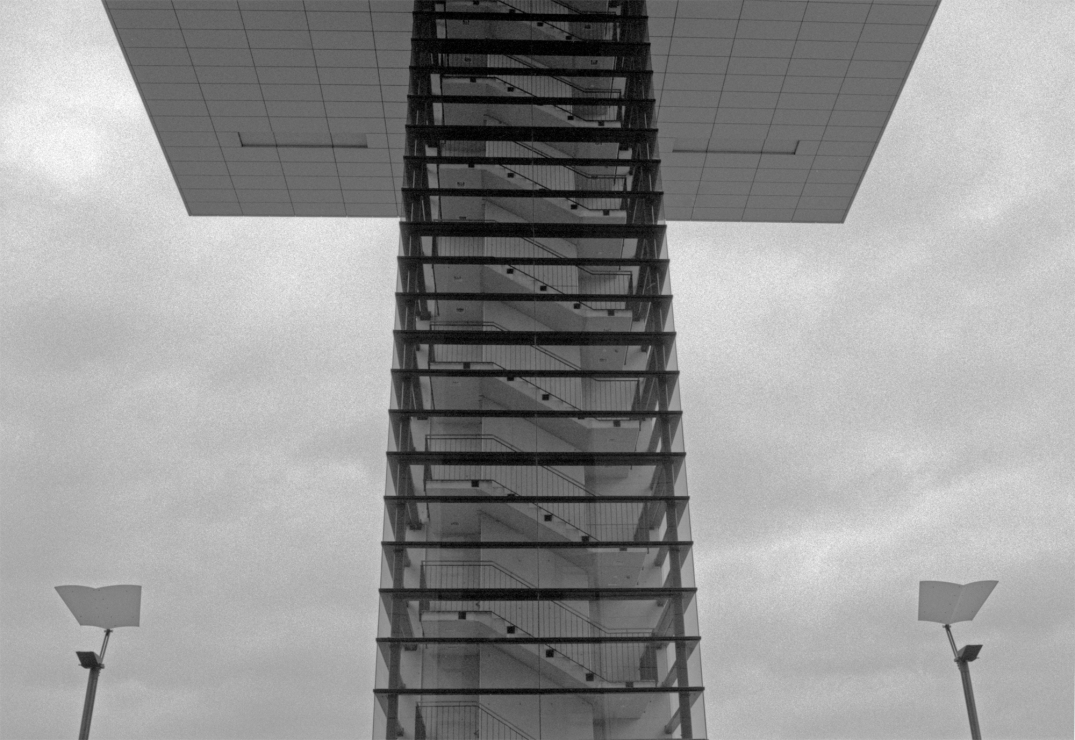
The photo above is from B/W and shows a so-called Kranhaus, one of three similar buildings lining the banks of the river Rhine in Cologne’s old harbor area. I was fascinated by the architecture, a reminiscence of the large cranes which back in the days were used to lift heavy freight from and into the hulls of cargo ships. The light conditions weren’t good, but I thought the grey sky and deep hanging clouds would counterbalance the strength and symmetry of the form and the almost clinical atmosphere of the stairhouse. I shot Ilford FP4+ and after developing it in Rodinal (1+50) the (intended) graininess of the picture added to this effect.

This is what I love when shooting film. It’s a process which makes you think beforehand: What kind of film did I load? Does it fit the scene I’m imagining? What kind of developing process will make the most out of it? All this slows you down and I experience this as a very relaxing and enjoyable exercise. Almost like a game. The image will materialize in your head already before you press the shutter release. Sure, when shooting digital you better go through the same process, but it’s tempting not to. Film kind of forces you into it – at least this is how it feels for me.

Where are the photos?

000001

You’re right, there is no photographs, yet. Neither to spice the blog nor under projects. The only image you’ve kind of seen is on my landing page. It’s a cropped version of the above photo showing a fallen trunk of a silver birch tree overgrown with ivy and some tree dwelling mushrooms. From their orientation perpendicular to the trunk axis one learns that the mushrooms only started growing after the birch crashed into the underwoods. It was a clear winter morning scene after light snowfall during the previous night. I found the trunk in a small woodland a few hundred meters from my home and its orientation was exactly parallel to what was the Berlin wall until 1990 some 50 meters away from this spot. I remember every minute of taking this photograph, because it was my very first medium format exposure using a Pentacon Six and its standard 80mm Biometar prime lens on Kodak Ektar 100. It’s quite a heavy camera and the borrowed and partly broken tripod was everything but convincing. I also had no lightmeter and wasn’t sure whether the build-in meter of my Canon AE-1 would do the job. But it all went well and although it’s not a brilliant photograph it means a lot to me, as this was the very moment that awoke my serious interest in photography again.


Note added Feb 11, 2019: I have changed the image of the landing page. The above photograph will now also find a home in the gallery “Landscape/Nature”. What used to be “projects” are now displayed on the landing page.

How it all began

As a kid, I was very passionate about photography. My first camera was a Kodak Instamatic 100, which I inherited from my mother.  I used this simple point-and-shoot toy a lot, but when my teen peergroup declared photography as something serious, a more decent device had to be found. This was my step into the SLR world. From then on I carried a heavy bag with a camera body,  several prime lenses, and a telephoto zoom wherever I went.  I was mainly interested in the nature, travel and landscape genres and – trying to be as professional a nature photographer as possible – I exclusively shot Kodachrome 64 transparencies. Thinking about it in retrospect makes me smile and you know why: I (naturally) never became a gifted nature photographer. Instead I got trapped in comparing my imagery with that of the real pros and being a subscriber to GEO magazine throughout the 80s and 90s did not help in this respect. As a consequence, I lost interest and ever so often I left my camera gear at home, because I couldn’t be bothered to carry all that weight only with the prospect of producing more mediocre results. It simply felt worthless. With the advent of digital cameras I got hooked again. Instant gratification by immediately seeing what I shot and the possibility to be restricted only by memory space and battery power and not by 36 slides per film was fascinating. I opted for a Fuji S602 bridge camera, which I thought would kill two birds with one stone: A light weighted body with an all-in-one focal length solution and the possibility to stop filling up my home with slideholders and -boxes. After about 5 years of companionship the electronics of the Fuji died beyond repair. And this was were it all ended … for the time being.

New ‘kid’ on the blog

Now it starts! This is my first blogpost ever on my freshly created website “Light & Grain”. Uhh, … I can already hear you: Why another photo website?  Any topic one can possibly think of is already covered in zillions of photo blog entries and online chats! There are so many professional photographers out there, so why should we bother to follow your humble beginnings, especially if you restrict yourself to film?

Or as Ted Forbes put it: “Nobody cares about your photography!”  And I must admit that you’re right, but …

About a year ago I re-discovered photography which I was very passionate about as a youngster. Reading an airline magazine article about the crash of Polaroid and its revival under the flag of the Impossible project somehow sparked my interest in film photography again. Back home I started digging for my old cameras safely stowed away in a worn-out photobag in our attic. And there they were. I unearthed my first SLR, a fully mechanical Fujica STX-1, with its light protection foam disintegrated into a gluey substance. Its replacement of the time was a Nikon F301, which sported an integrated motordrive. I obviously kept the useless camera body despite its unexpected final breakdown in 1991. Being fed up with electronics in camera bodies I went fully mechanical again and invested in a Nikon FM2. With this camera I experienced the most rewarding time in photography so far. It was my day-to-day camera for more than a decade before I stopped shooting film. Digging deeper, I also found some old gems from the 1960s I had completely forgotten about. One was a well preserved Agfa Clack box camera, which once belonged to my father, the other one was a Voigtländer Vitomatic II rangefinder inherited from my wife’s grandpa. All these cameras had been waiting for me in the old bag ever since. They were the founding stock of what is now a small collection of analogue cameras, which I happily used to start shooting again.  Some 50 rolls of small and medium format film later it’s now time to share my renewed passion with you.